
Is Rutgers University Hard to Get Into? Real Acceptance Rates Explained

Rutgers University stands as one of the nation’s foremost public research universities. Each year, thousands of students aspire to gain admission to this prestigious institution, renowned for its academic excellence and diverse student community. However, with a competitive acceptance rate and a selective admissions process, many prospective students question: Is Rutgers University difficult to get into? In this article, we will delve into Rutgers’ acceptance rates, explore the key factors that influence the admissions decision, and provide actionable insights on how to enhance your application and improve your chances of acceptance.
Understanding Rutgers University’s Acceptance Rate
Rutgers University’s acceptance rate stands at approximately 60%. This means that out of every 100 applicants, 60 are admitted. While this suggests that getting into Rutgers is competitive, it is still accessible for students who meet the university’s academic and extracurricular expectations.
However, the rate can vary depending on the program. Some programs, such as those in business or engineering, tend to have stricter admission criteria, meaning fewer students are accepted. Therefore, understanding the specific Rutgers requirements for your chosen program, such as GPA, test scores, and extracurricular involvement, is crucial. Tailoring your application to these factors can significantly increase your chances of acceptance.
Factors That Affect Admission to Rutgers University and How to Improve your chances
Getting into Rutgers University requires more than just meeting the minimum academic standards. Several factors impact your chances of acceptance, and understanding these elements can help you improve your application.
- GPA (Grade Point Average)
Your GPA is one of the most significant factors in the admissions process. Rutgers typically admits students with a GPA of 3.5 or higher, with the average GPA for admitted students being around 3.7. To improve your chances, aim for a GPA close to or above this average. Taking advanced coursework, such as AP, IB, or honors classes, can further demonstrate your academic strength.
Reference: Rutgers University reports that the average GPA for incoming students is 3.7. - Standardized Test Scores (SAT/ACT)
While Rutgers has adopted a test-optional policy, submitting high SAT or ACT scores can still be beneficial, especially if your GPA is not as strong. The middle 50% SAT score range for admitted students is 1300-1520, and the ACT score range is 28-34. If you choose to submit scores, aim for scores within or above this range to make your application more competitive.
The average SAT score for Rutgers students is around 1400, and the average ACT score is 31. - Extracurricular Activities
Rutgers University values students who are actively involved in extracurricular activities. Leadership roles, community service, and participation in clubs, sports, or other organizations can make you stand out. Focus on depth rather than breadth—having a few meaningful experiences can be more impressive than being involved in many activities without much impact.
Rutgers admissions notes that extracurricular involvement is a critical part of their holistic review process. - Essays and Personal Statements
The personal essay is your opportunity to show Rutgers who you are beyond your academic achievements. A compelling essay can be the deciding factor if your GPA and test scores are average. Write a thoughtful, authentic essay that reflects your passion for learning, personal growth, and reasons for wanting to attend Rutgers.
Admissions officers at Rutgers emphasize the importance of the personal statement in their holistic review, noting that it allows them to get to know applicants on a deeper level.
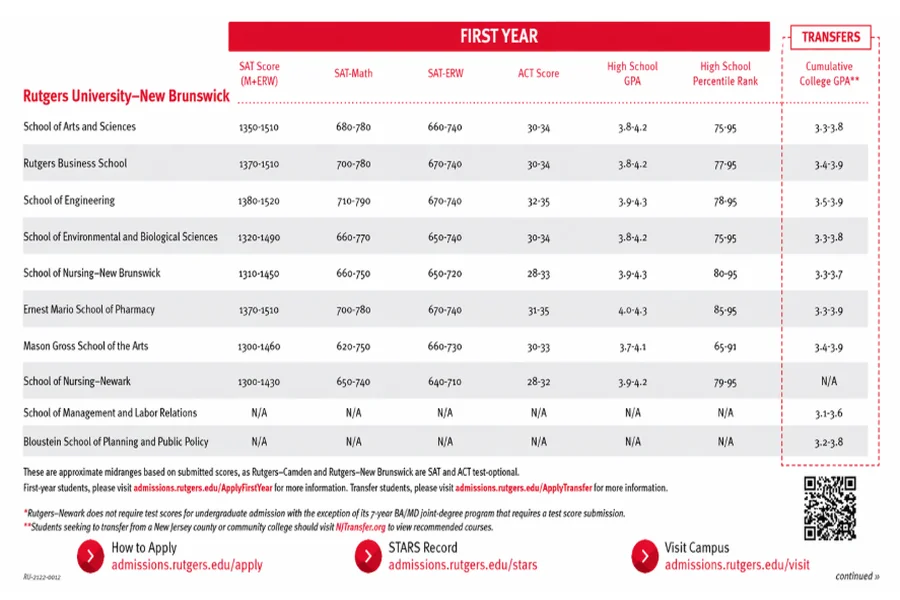
Program-Specific Admissions: What You Need to Know
While Rutgers University has general admission requirements, many of its programs have specific criteria that can affect your chances of acceptance. These program-specific requirements can include higher GPAs, specialized coursework, supplemental materials, or even interviews. Below are some key details to keep in mind when applying to highly competitive programs at Rutgers:
- Rutgers Business School
The admissions process for the Rutgers Business School is more competitive than the general university admissions. Applicants to the Business School need to have a strong academic record, typically with a GPA of 3.5 or higher, and must have completed specific math and business-related courses in high school. Additionally, a well-rounded application with extracurricular activities that demonstrate leadership or business-related experiences can enhance your chances.
Business School applicants should also be aware of any additional essays or interviews that may be required, depending on the program. - School of Engineering
The School of Engineering at Rutgers has rigorous admissions standards. Engineering applicants are expected to have a solid foundation in math and science, including advanced coursework such as calculus and physics. The average GPA for accepted engineering students tends to be higher than the general Rutgers average, typically above 3.7. Strong SAT or ACT scores, particularly in math and science, can also improve your chances.
The Rutgers School of Engineering typically looks for a strong academic background in STEM subjects, and applicants should be prepared to submit additional materials like recommendation letters or portfolios, depending on the program. - School of Nursing
The Rutgers School of Nursing has specific prerequisites for applicants, including required high school coursework in science (biology and chemistry) and a minimum GPA. The nursing program is competitive, and the school places a heavy emphasis on both academic excellence and relevant healthcare experience. Applicants must submit a personal statement outlining their interest in nursing, as well as any clinical or volunteer experience in the healthcare field.
The average GPA for nursing students is typically higher than the general acceptance rate, often around 3.8 or above. - School of Arts and Sciences
The School of Arts and Sciences (SAS) has slightly less stringent requirements compared to the professional schools, but it’s still highly competitive. While GPA and SAT scores are important, SAS also places a strong emphasis on your interests and academic potential, particularly if you’re applying for competitive majors such as Psychology, Biology, or Political Science.
Applicants to SAS should also be aware of any program-specific prerequisites, such as advanced coursework or specific test scores, especially for selective fields like pre-med or pre-law.
Conclusion
Getting into Rutgers University can be competitive, but with the right preparation, it’s achievable. Key factors like GPA, standardized test scores, extracurricular activities, essays, and program-specific requirements all play a critical role in the admissions process. To improve your chances, focus on strengthening your academic performance, engaging in meaningful extracurriculars, and tailoring your application to meet program-specific criteria. By doing so, you can increase your chances of being admitted to Rutgers University and set yourself up for success in your academic journey.