
Is a Home Maths Tutor Worth It? What Singapore Parents Need to Know
At some point, most parents in Singapore ask themselves this question.
Their child is struggling with Maths. School is not quite filling the gap. Sitting at the kitchen table trying to explain problem sums is starting to cause more friction than progress. And someone in their parent WhatsApp group has just mentioned they hired a tutor and things have turned around.
So is it worth it? Honestly, it depends. But for many families, the answer ends up being yes, and often they wish they had started sooner.
What a home tutor actually does differently
There is a tendency to think of tuition as simply more school. Same content, same methods, just in a smaller setting.
The best home tutors do not work that way. They start by figuring out how a child thinks, not just what they do not know. A child who gets fraction questions wrong consistently is not necessarily confused about fractions. They might be misreading the question. They might be making the same procedural error every time without realising it. They might have a gap from two years ago that nobody caught.
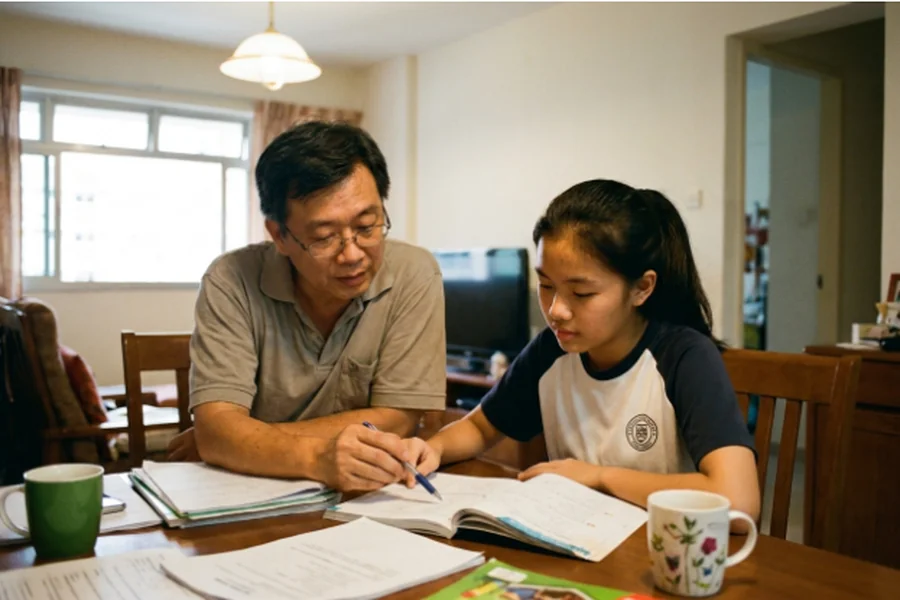
A tutor who sits with a child one-on-one has the time and space to find that out. A teacher managing thirty students in a classroom rarely does.
The convenience factor is real
One reason home tuition has grown in popularity in Singapore is straightforward. It fits around family life in a way that travelling to a tuition centre does not always manage.
There is no commute after a long school day. No sitting in traffic or rushing from one side of the estate to another. The child is in a familiar environment, which for many kids actually means they are more relaxed and receptive than they would be in an unfamiliar classroom setting.
For parents with younger children especially, having a tutor come to the home removes a significant logistical headache. And a child who arrives at a session calm rather than frazzled tends to absorb more from it.
What to look for before hiring anyone
This part matters more than most parents give it credit for.
Teaching experience is not the same as tutoring experience. Someone who was strong at Maths in school or university is not automatically a good tutor. The ability to explain a concept clearly, to notice when a child has not understood despite nodding along, and to try a different approach when the first one does not land, these are skills that develop through time spent actually teaching.
A background in MOE schools is worth asking about. Tutors who have taught in Singapore’s local school system understand the curriculum, the exam expectations, and the specific ways questions are structured at each level. That alignment matters when the goal is to improve results in Singapore’s national exams.
Ask how they handle it when a child is stuck. Ask whether they adapt their approach to different learning styles. Ask what a typical session looks like. The answers will tell you a lot about whether this is someone who genuinely knows how to teach or someone who simply knows the content.
The question of fees and what is reasonable
Home tuition in Singapore sits across a fairly wide range depending on the tutor’s background, the level being taught, and whether sessions are one-on-one or in a small group.
Understandably, many parents look for the most affordable option. But the cheapest tutor is not always the most cost-effective one. A child who spends six months with a tutor who cannot quite identify what is going wrong, and makes limited progress, has spent both money and time that cannot be recovered before an exam.
Transparency around fees matters. A tutor or tuition provider who is clear about what is included, the number of sessions, the resources provided, and what happens if your child needs more support between lessons, is worth more than one who keeps things vague. If you are comparing options, it is worth checking what a reputable home tutor for Maths charges and what that actually includes, so you have a realistic benchmark.
Online versus in-person: does it matter?
A few years ago, most parents would have said yes, strongly in favour of in-person. That has shifted.
Online tuition, when it is delivered well, can be just as effective as face-to-face sessions for most students. The key is engagement. A passive online session where a child sits watching a tutor explain things on a screen is not much better than a YouTube video. But an interactive session where the tutor can see the child’s working in real time, ask questions, and respond to confusion as it happens, works remarkably well.
For children who are self-motivated and comfortable with technology, online tuition is often a genuinely good fit. For younger children or those who find it harder to stay focused without physical presence, in-person tends to work better. Knowing your child well enough to make that call honestly is half the battle.
How long before you see results
This is the question every parent wants answered upfront, and the honest answer is that it varies.
A child with a few specific gaps who starts tuition early enough will often show noticeable improvement within a month or two of consistent sessions. A child with deeper, longer-standing gaps might take a full term before the progress becomes obvious in their grades, even if the understanding is genuinely building underneath.
What tends to slow things down is inconsistency. Skipping sessions. Not doing the practice in between. Expecting the tutor to do all the work while the child remains passive. Tuition is not a passive process. The child still has to show up, engage, and be willing to work through the uncomfortable feeling of not knowing something yet.
A good tutor will keep that motivation going. But the family has to support it too.
A few signs it might be time to make a decision
Some parents wait for a dramatic failure before acting. That is understandable, but it means a lot of unnecessary struggle in the meantime.
If your child regularly avoids Maths homework or says they hate the subject, that is worth taking seriously. Avoidance is almost always rooted in anxiety or a feeling of incompetence, and both tend to get worse without intervention, not better.
If their school results have been declining across two or more terms, the gap is already widening. If they consistently struggle with the same topic types despite revision, there is likely a conceptual misunderstanding that needs a different kind of attention than more practice can provide.
None of these are reasons to panic. But they are reasons to stop waiting and start looking.
Getting the decision right for your family
There is no single right answer when it comes to tuition. What works brilliantly for one child might not suit another at all.
What matters is being honest about what your child actually needs, not what is most convenient or what everyone else is doing. Some children genuinely thrive with the right one-on-one support. Others do better in small groups where the social element keeps them engaged. Some families find that structured online sessions fit their life far better than anything in-person could.
Take the time to find what fits. Ask questions before committing. And if something is not working after a fair trial, do not be afraid to change course. The goal is your child’s progress, not loyalty to a particular arrangement.